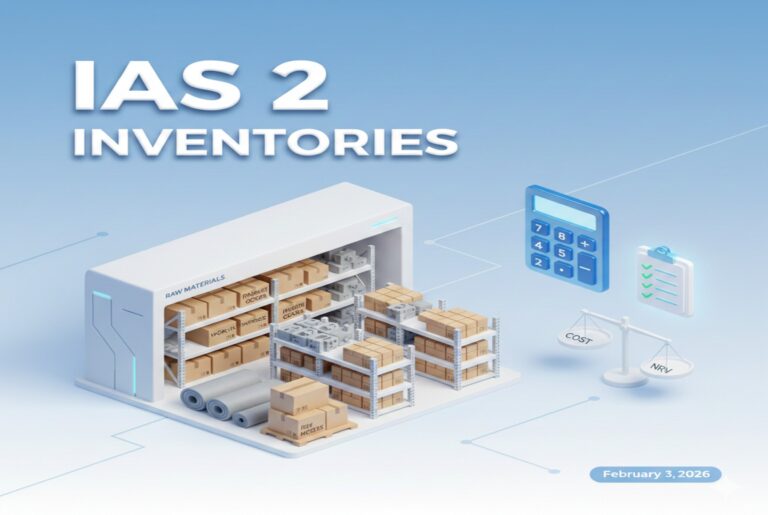
Published: 3 February 2026
IAS 2 Inventories sets out the accounting treatment for inventories, including how they should be measured, classified, and disclosed in financial statements. The primary objective of the standard is to ensure inventories are carried at an appropriate value and expenses are recognised in the correct accounting period.
Inventories are assets:
Held for sale in the ordinary course of business
In the process of production for such sale
In the form of materials or supplies to be consumed in production or service delivery
IAS 2 does not apply to the following:
Financial instruments (covered under IAS 32 and IFRS 9)
Biological assets related to agricultural activity (covered under IAS 41)
IAS 2 also superseded SIC-1 Consistency—Different Cost Formulas for Inventories, providing clearer guidance on inventory valuation.
Under IAS 2, inventories must be measured at the lower of cost and net realisable value (NRV).
The cost of inventories includes:
Purchase costs (net of trade discounts and rebates)
Conversion costs
Other costs incurred in bringing inventories to their present location and condition
NRV is defined as:
Estimated selling price less estimated costs of completion and costs necessary to make the sale
If NRV falls below cost, the inventory must be written down.
According to IAS 2, inventories should be measured using one of the following cost formulas:
FIFO (First-In, First-Out)
Weighted Average Cost (WAC)
FIFO assumes that inventories purchased first are sold first. As a result, closing inventory reflects the most recent purchase prices.
The WAC method calculates an average cost based on:
The cost of similar items at the beginning of the period, and
The cost of items purchased or produced during the period
Entities must apply the same cost formula to inventories of a similar nature and use. Different formulas may be used if inventories differ significantly in nature or use.
The following costs are excluded from inventory valuation and are recognised as expenses when incurred:
Abnormal waste of materials, labour, or production costs
Storage costs (unless necessary during production before a further stage)
Administrative overheads not related to bringing inventories to their present condition
Selling and distribution costs
The following costs are excluded from inventory valuation and are recognised as expenses when incurred:
Abnormal waste of materials, labour, or production costs
Storage costs (unless necessary during production before a further stage)
Administrative overheads not related to bringing inventories to their present condition
Selling and distribution costs
IAS 2 requires entities to disclose the following in their financial statements:
Accounting policies adopted for inventory valuation
Carrying amounts of inventories, classified as raw materials, work in progress, and finished goods
Inventories measured at fair value less costs to sell
Amount of inventory write-downs recognised as an expense
Reversals of inventory write-downs and reasons for such reversals
Cost of inventories recognised as cost of goods sold
Inventories pledged as security for liabilities
IAS 2 plays a crucial role in ensuring accurate inventory valuation and proper expense recognition. Correct application of the standard improves financial transparency, supports better decision-making, and ensures compliance with IFRS reporting requirements.
👉 Contact Direct Assist Accountants today for a free consultation or instant online quote.
Direct Assist Chartered Certified Accountants helping businesses make smarter financial decisions.
Excellent rating
Based on 84 reviews
(0203) 633 2018
info@directassistaccountants.co.uk
Provide your details and one of our experts will be in touch.